
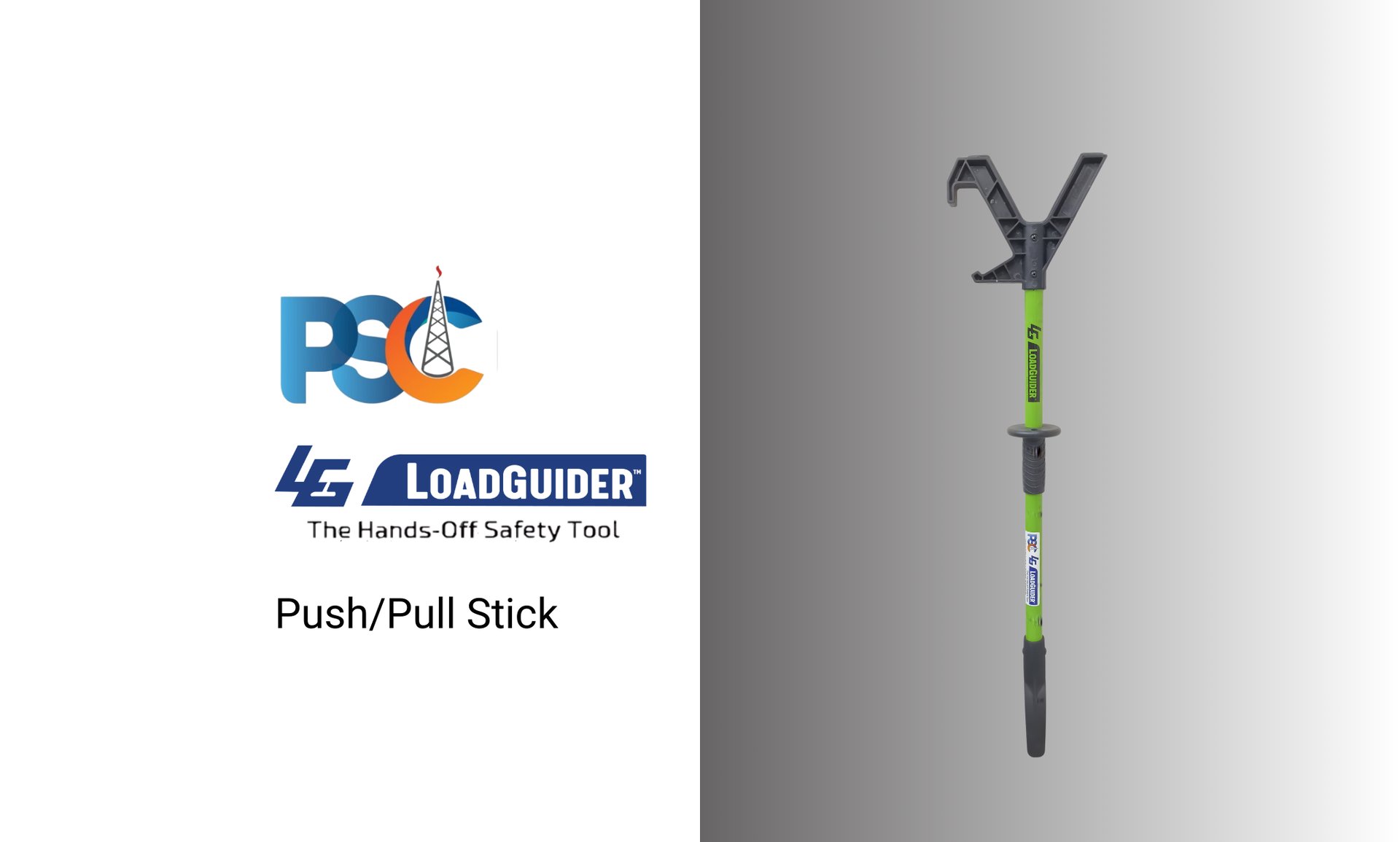
PSC LOADGUIDER®-PUSH/PULL STICK
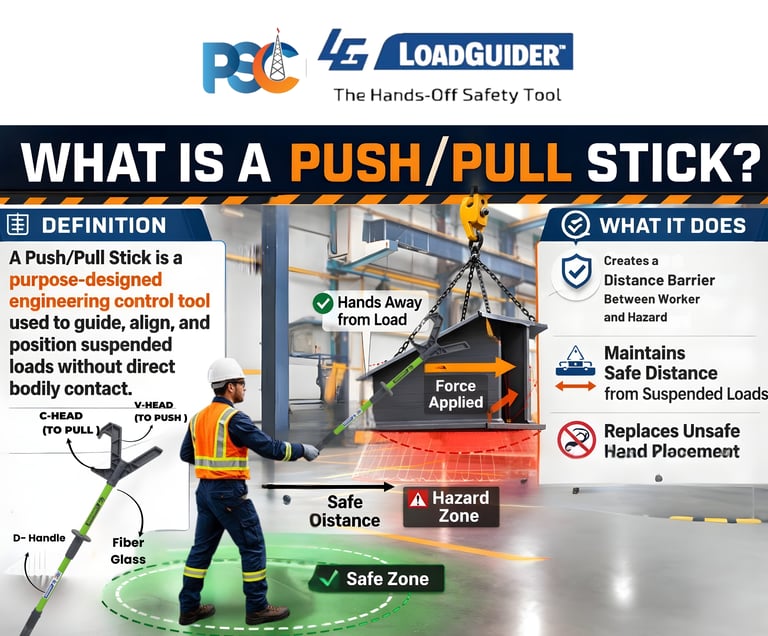
What is a Push/Pull Stick?
A Push/Pull Stick is a purpose-designed engineering control Stick that enables operators to influence the position, alignment, and movement of suspended loads without direct bodily contact.
It is typically constructed from non-conductive fiberglass, composite, or engineered polymers and fitted with a shaped head (hook, fork, cup, pad, or multi-profile head) that allows controlled contact with loads, rigging components.
From an HSE standpoint, the Push/Pull Stick functions as:
A distance barrier between worker and hazard
A distance-creating device
A behavior-replacing control (replaces unsafe hand placement)
Rather than relying on workers to “be careful,” the Stick eliminates the need to place hands near hazards in the first place.
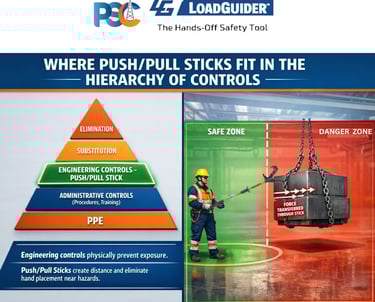
Where Push/Pull Sticks Fit in the Hierarchy of Controls
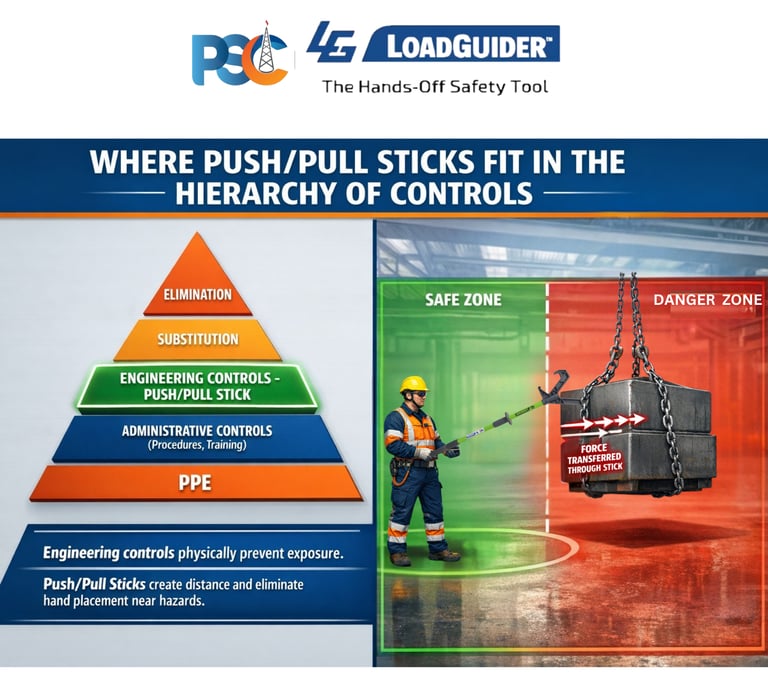
Push/Pull Sticks sit at the Engineering Control level of the hierarchy:
Elimination
Substitution
Engineering Controls (Push/Pull Stick)
Administrative Controls (procedures, training)
PPE
This is critical because:
PPE only reduces severity
Procedures rely on perfect human behavior
Engineering controls physically prevent exposure
Push/pull sticks therefore provide inherently safer work design.
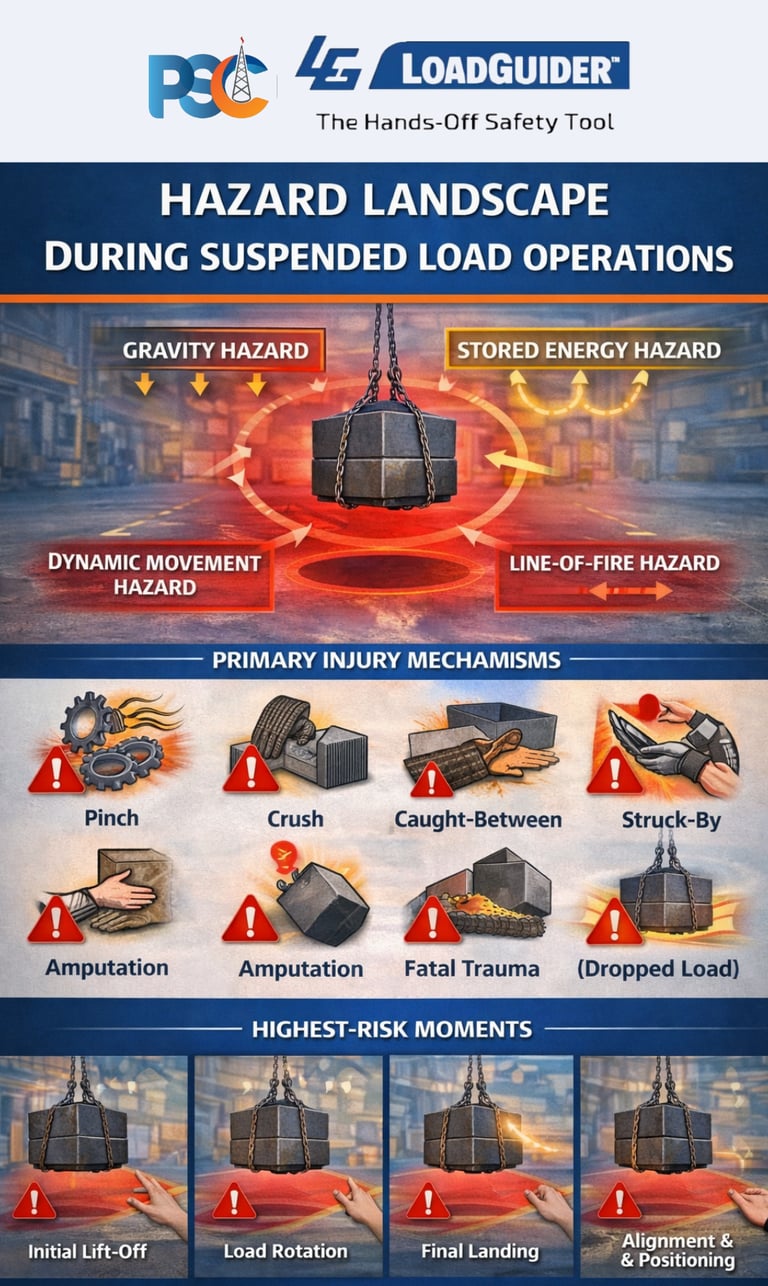
Hazard Landscape During Suspended Load Operations
Suspended load handling simultaneously creates:
Gravity hazards
Stored energy hazards
Dynamic movement hazards
Line-of-fire hazards
Primary injury mechanisms:
Pinch
Crush
Caught-between
Struck-by
Amputation
Fatal trauma from dropped loads
Most injuries occur during:
Initial lift-off
Load rotation
Final landing
Alignment and positioning
These moments historically require hand
placement — the highest risk behavior.
Detailed Operational Use
A) Before the Lift
Confirm lift plan specifies Push/Pull Stick
Verify correct stick length selected
Inspect stick for damage
Confirm communication method (radio / hand signals)
B) During the Lift
Operator positions body outside fall zone
Stick remains between worker and load at all times
Use controlled Push/Pull pressure only
Maintain two-handed grip
Adjust stance to avoid line-of-fire
C) During Landing
Use stick to guide final alignment
Do not place hands on load edges
Once load is stable and blocked, remove stick
D) After the Lift
Stow stick properly
Report any damage
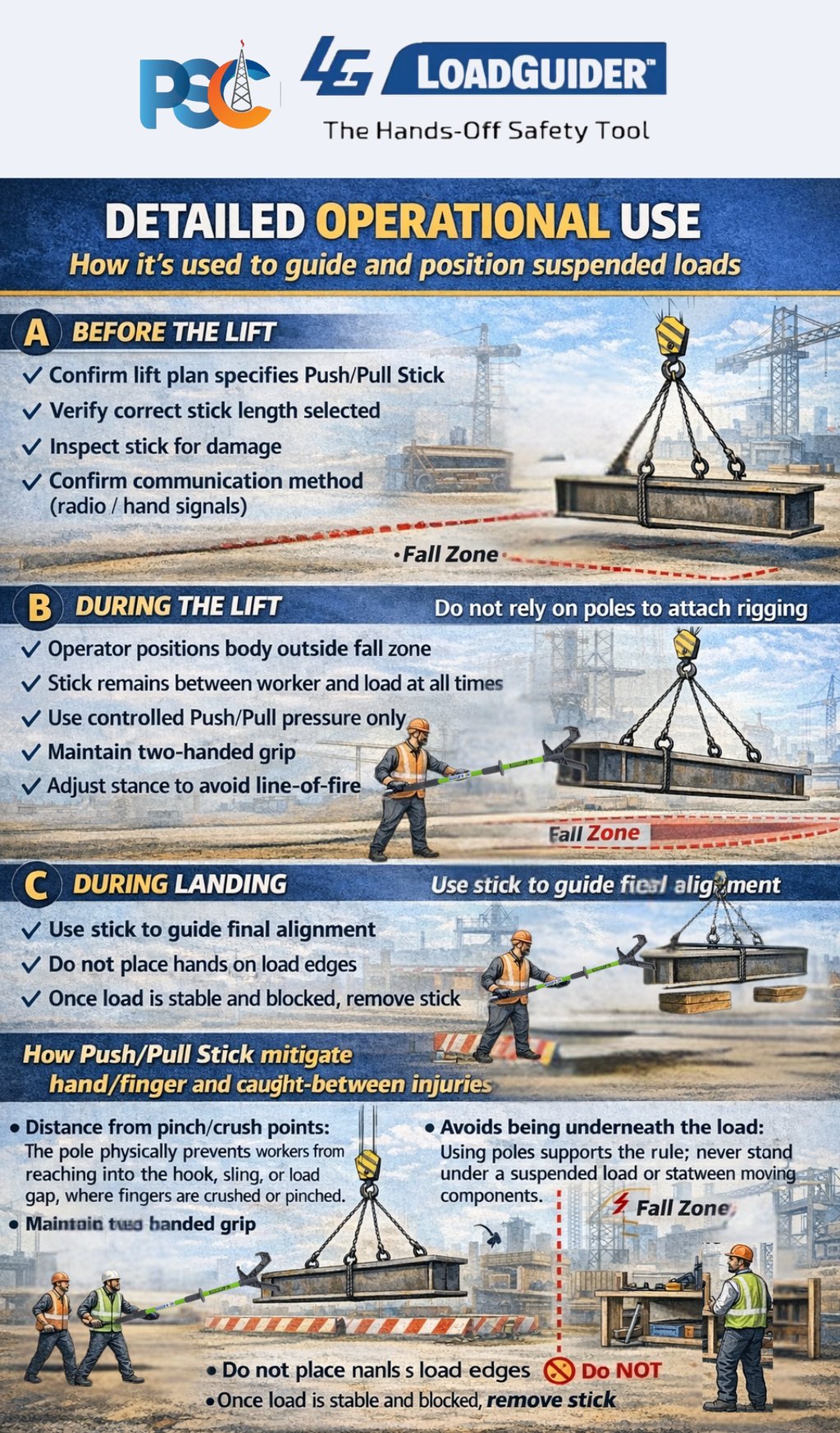
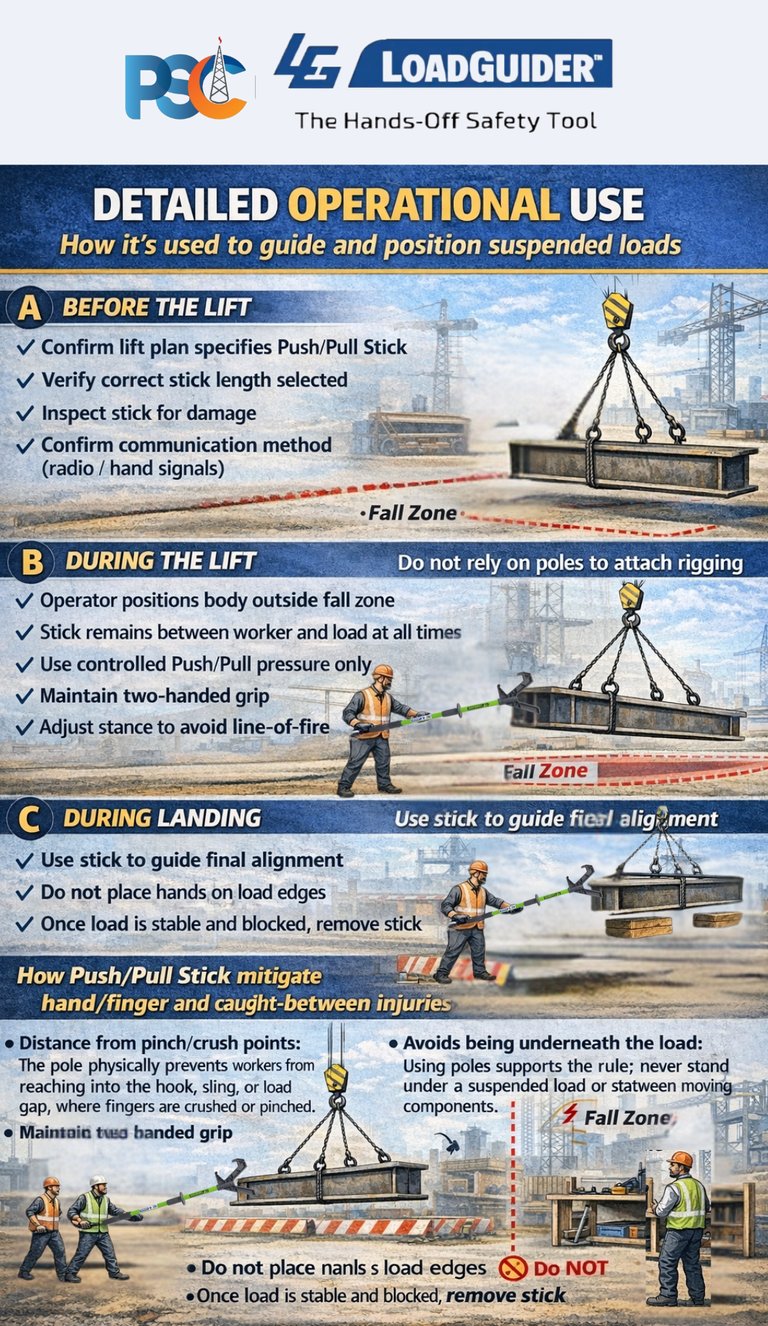
How Push/Pull Stick mitigate hand/finger and caught-between injuries
Distance from pinch/crush points: The Stick physically prevents workers from reaching into the hook, sling, or load gap where fingers are crushed or pinched. This is the primary protective mechanism.
Control of uncontrolled motion: By stabilizing rotation and swing, Sticks reduce sudden motions that can trap hands between load and structure or between moving components.
Reduces need to grab slings: Sticks allow snagging/handling of slings without manual contact — removing direct hand exposure to “caught-between” hazards.
How it’s used to guide and position suspended loads
Attach rigging (do not rely on Sticks to connect slings). Ensure lift plan and Stick talk confirm the use of a guide Stick.
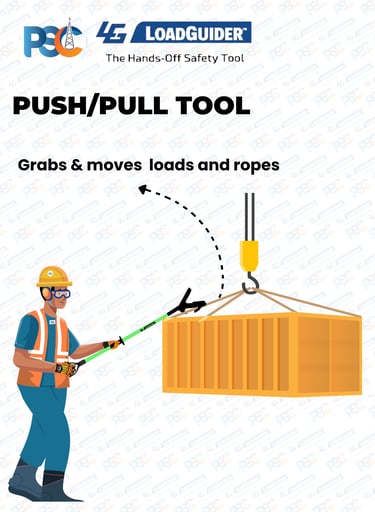
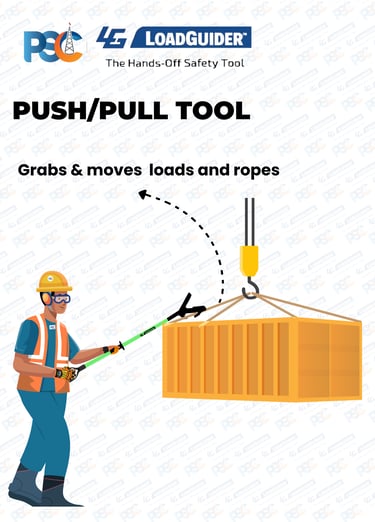
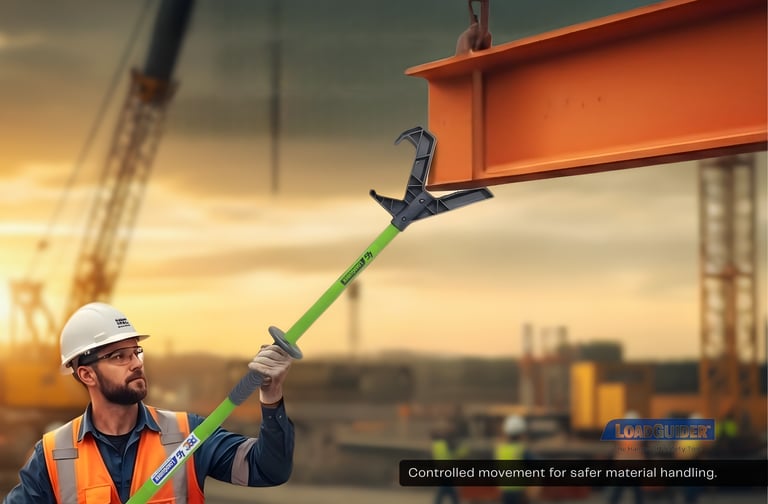
Keep the Stick between worker and load — use the Stick to Push, Pull, nudge or steady the load from a distance rather than placing hands on the load or rigging. Use two-hand grip for control.
Use the Stick to snag or control and sling legs (Pulling them out of the way or stabilizing rotation) so workers never put fingers into pinch/crush zones.
Communicate with crane operator/spotters (hand signals or radio) while guiding — Stick usage does not replace signalling or landing procedures.
After landing, chock/block the load and stow the Stick. Inspect Stick before/after use.
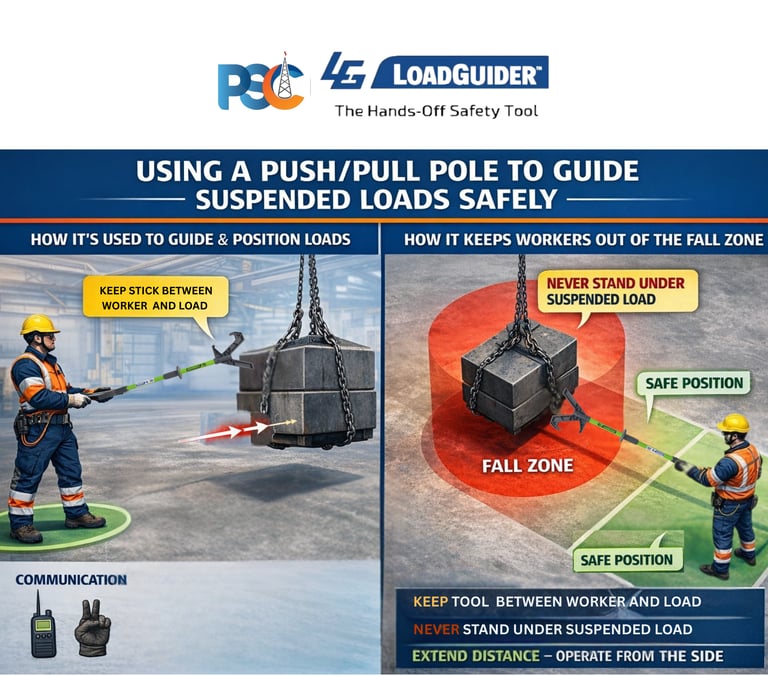
How the Stick keeps workers out of the fall (fall-zone) area
Extends handler’s standoff distance: A Stick lets the handler operate farther from the vertical projection (fall zone) of the suspended load. Guidance for commonly recommends keeping handlers at a distance multiple times the lift height (see length guidance below) so they are outside the area where a dropped load or falling debris would land.
Avoids being underneath the load: Using Sticks supports the rule: never stand under a suspended load — theStick enables movement and alignment from the side, not below. Operational discipline to back away after making adjustments is still required.
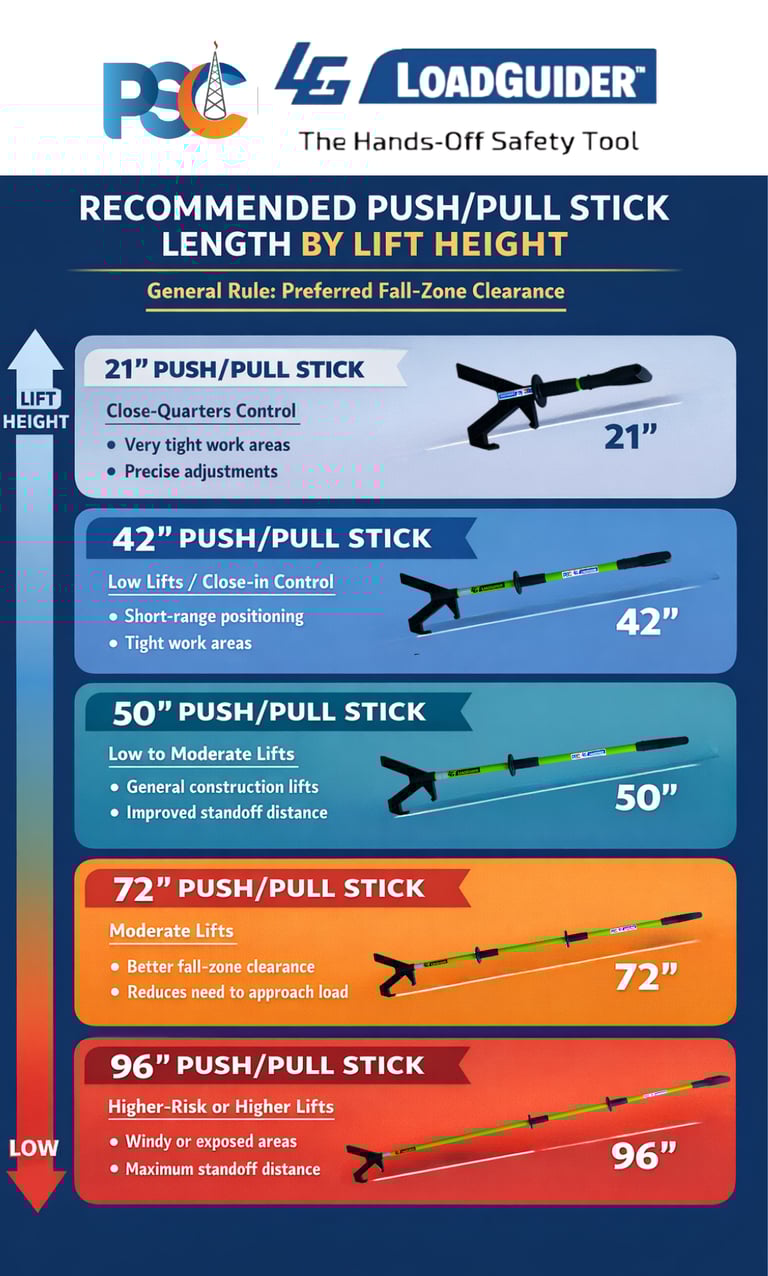
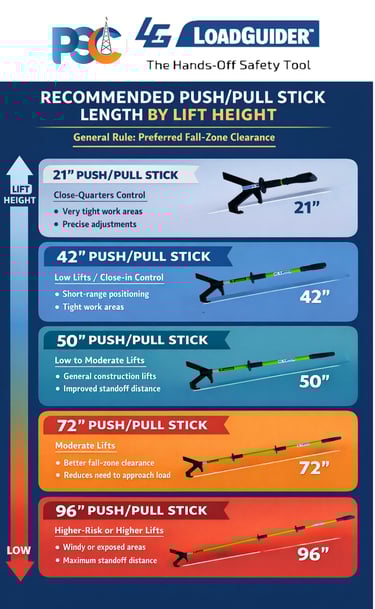
RECOMMENDED PUSH/PULL STICK LENGTH BY LIFT HEIGHT
General Rule
Preferred fall-zone clearance
21" PUSH/PULL STICK
Close-Quarters Control
• Very tight work areas
• Precise adjustments
42” PUSH/PULL STICK
Low lifts / close-in control
• Short-range positioning
• Tight work areas
50” PUSH/PULL STICK
Low to moderate lifts
• General construction lifts
• Improved standoff distance
72” PUSH/PULL STICK
Moderate lifts
• Better fall-zone clearance
• Reduces need to approach load
96” PUSH/PULL STICK
Higher-risk or higher lifts
• Windy or exposed areas
• Maximum standoff distance
PSC Load Guider Push/Pull Stick
Additional safe-use recommendation
Inspect before use (cracks, loose heads, worn tips). Replace damaged Sticks.
Use gloves, eye protection and non-slip footwear. Even with a Stick , PPE reduces residual hazards.
Never use a Stick to support the load — Sticks are control Sticks, not load-bearing devices. Do not hook a Stick under load to lift or carry weight.
Secure Sticks when not in use (stow to avoid trip hazards).
Do not tie multiple Sticks together to extend reach in ways not intended by manufacturer; use purpose-designed longer or mechanical/remote options.
Safety Guidelines
Never touch a suspended load directly.
Stay out of the red zone beneath loads.
UseStick for guiding only — not load-bearing.
Inspect before each use.
Do not use near live electrical sources unless rated.
Always follow site lift plan and JSA.
Why Choose PSC LoadGuider®-Push/Pull Stick?
Engineered specifically for industrial lifting safety
Designed to support hands-free safety culture
Reduces recordable hand injuries
Improves operational efficiency
Built for durability in extreme environments
PSC LoadGuider-Push/Pull Stick is more than a Stick — it is a commitment to zero hand injuries.
Part Numbers
PSC-LG-42
PSC-LG-50
PSC-LG-72
PSC-LG-96
Limitations
Tall lifts where safe standoff requires very long reach — use remote control.
High wind or unstable loads — control may be insufficient; technical rigging solutions required.
Short checklist you can use in a SOP
Lift plan notes Push/Pull Stick use and length chosen (state formula used).
inspected and fit-for-purpose.
Handler positioned at safe standoff
Two-hand grip, gloves, eye protection.
Clear communication with crane operator.
Load landed and blocked before approaching underload.
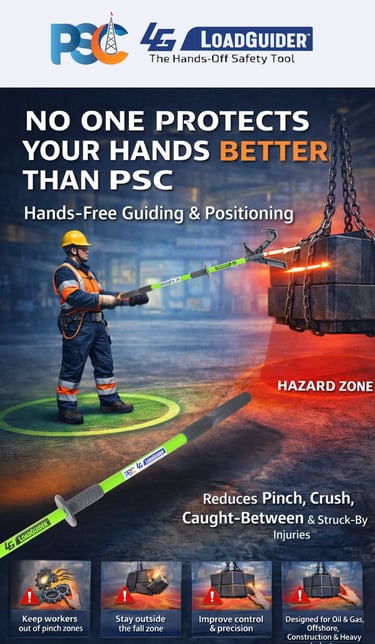
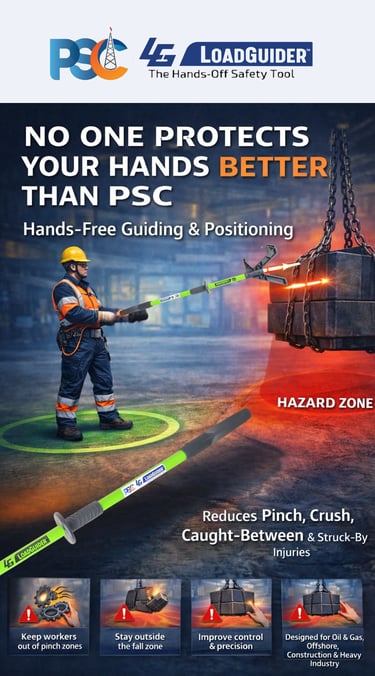
No One Protects Your Hands Better Than PSC.
Reduce pinch, crush, caught-between, and struck-by injuries with the PSC LoadGuider®-Push/Pull Stick— engineered for hands-free guiding and positioning of suspended loads in high-risk industrial environments.
✔ Keep workers out of pinch zones
✔ Stay outside the fall zone
✔ Improve control & precision
✔ Designed for Oil & Gas, Offshore, Construction & Heavy Industry
Why Hands-Free Load Control Matters
Hand and finger injuries make up a large portion of industrial accidents, especially during load landing, alignment adjustments, handling, and last-minute positioning.
Direct contact with suspended loads exposes workers to serious hazards such as caught-between incidents, crush injuries, amputations, and struck-by accidents.
The PSC LoadGuider-Push/Pull Stick removes the need for direct contact by extending the operator’s reach, creating a safe distance barrier between the worker and the suspended load.
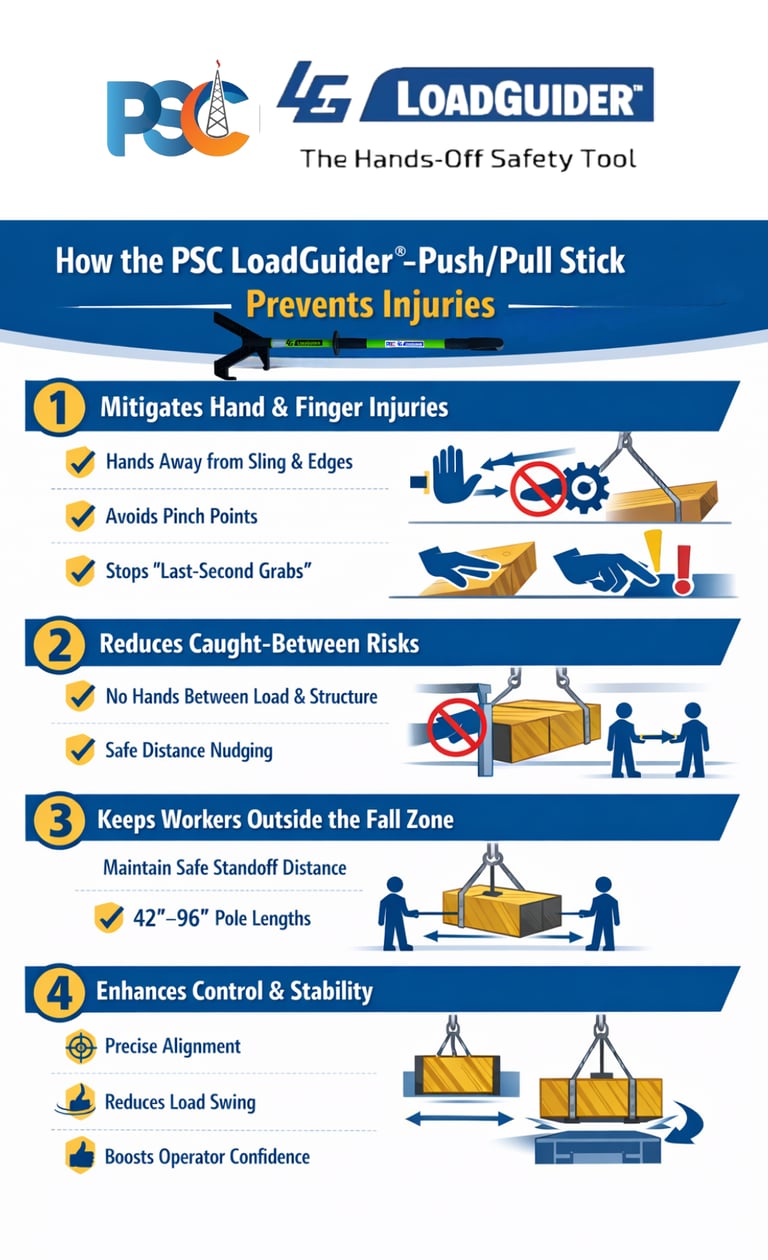
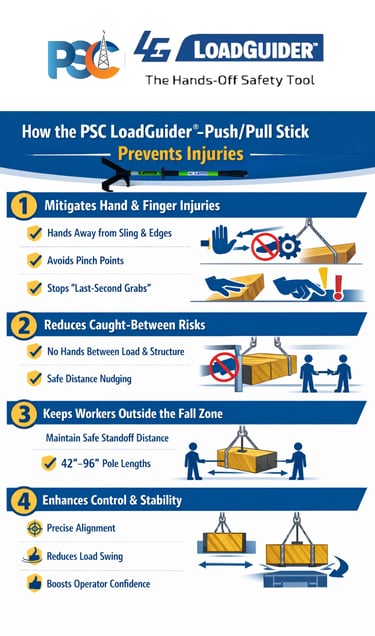
How the PSC LoadGuider®-Push/Pull Stick Prevents Injuries
1️⃣ Mitigates Hand & Finger Injuries
Keeps hands away from sling legs and load edges
Prevents finger insertion into pinch gaps
Eliminates “last-second grab” injuries
2️⃣ Reduces Caught-Between Risks
No need to place hands between load and structure
Allows safe nudging from controlled distance
3️⃣ Keeps Workers Outside the Fall Zone
Industry best practice recommends maintaining safe standoff distance during lifting operations. The PSC LoadGuider-Push/Pull Stick available lengths (42”–96”) allow operators to remain outside the vertical drop zone of suspended loads.
4️⃣ Enhances Control & Stability
Improves precision alignment
Reduces uncontrolled load swing
Increases operator confidence
Technical Specifications
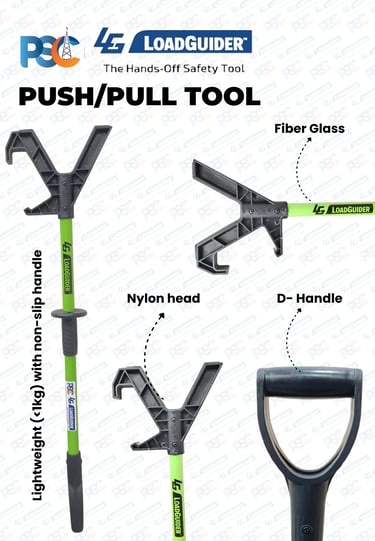
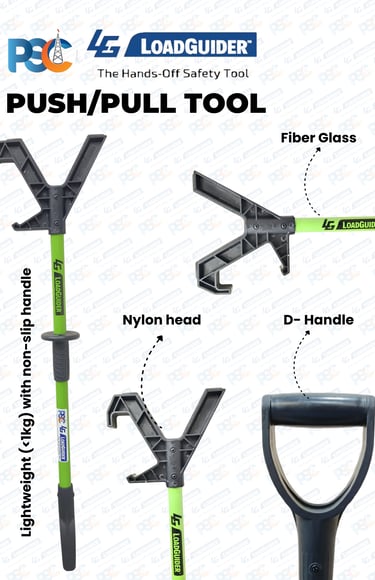
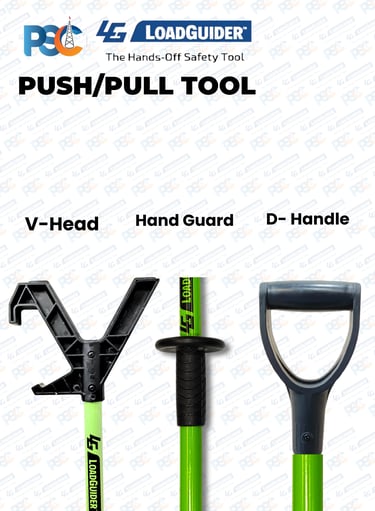
Body Material: Fiberglass Shaft
Head Material: Durable Nylon
Additional Components: Industrial-grade plastics
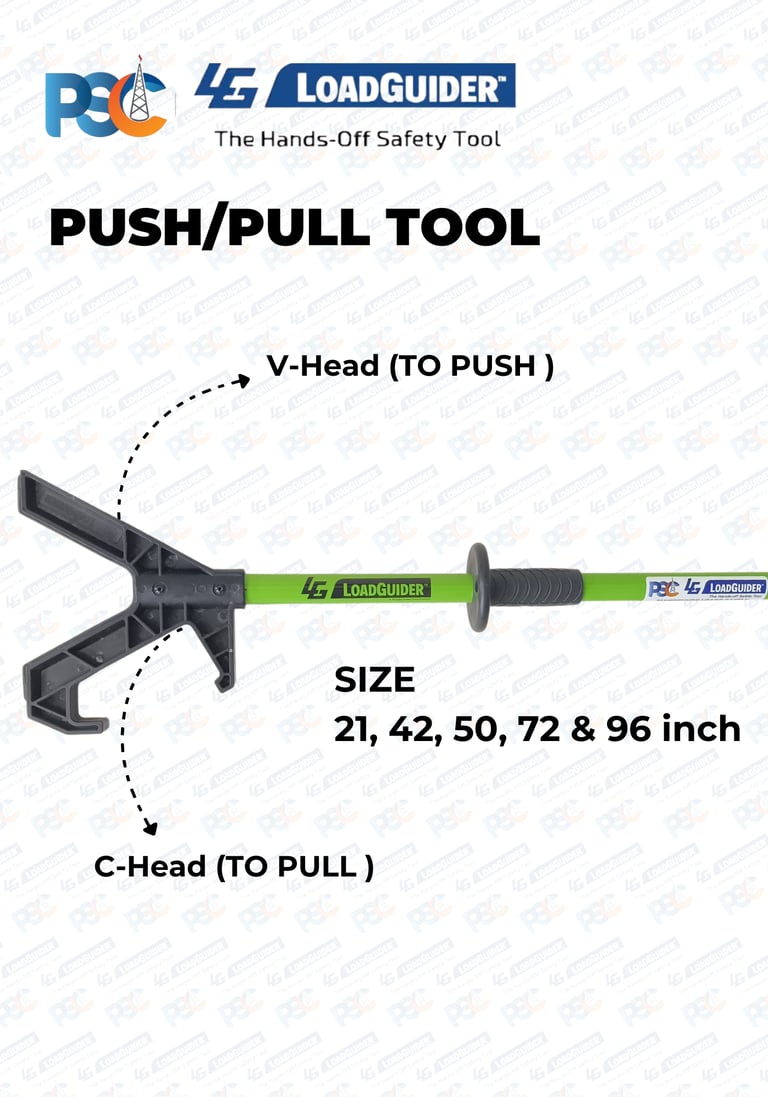
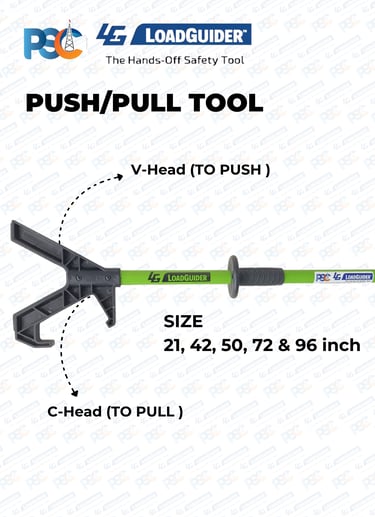
Available Size : 42”, 50”, 72”, 96”
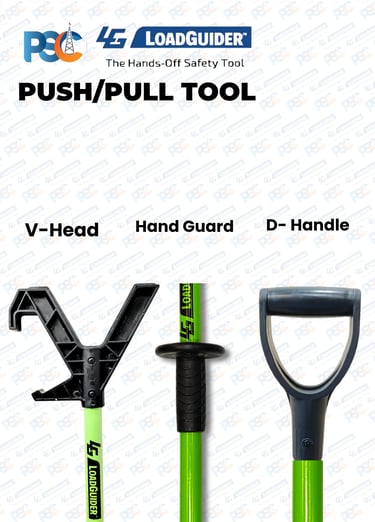
Lightweight. Corrosion-resistant. Ergonomic D-handle for secure grip.
Choosing the Right
PSC LoadGuider®-Push/Pull Stick Size
Choosing the correct PSC LoadGuider®-Push/Pull Stick
Size is essential for safe lifting operations.
Size → 42”
Size → 50”
Size → 72”
Size → 96”
Longer Sticks provide greater standoff distance, helping keep
workers out of red zones and reducing exposure to pinch, crush,
and fall hazards.
Industries We Serve
Offshore Oil & Gas
Onshore Drilling
Construction & Infrastructure
Steel Plants
Shipyards & Maritime
Power & Utilities
Heavy Manufacturing
Wherever suspended loads exist — PSC protects hands.
Key Features
✔ Extremely lightweight design
✔ Ergonomic non-slip D-handle
✔ Non-conductive fiberglass shaft
✔ High load strength
✔ Corrosion-resistant construction
✔ Quick deployment — no setup required
✔ Designed for harsh industrial environments
Protect Your Team — Choose PSC LoadGuider®-Push/Pull Stick
Upgrade PSC LoadGuider®-Push/Pull Stick To Protect Your Workforce. Prevent Injuries. Go Hands-Free Today.
📞 +91 9100932334
📧 info@projectsalescorp.com
🌐 pschandsfree.com
PSC LoadGuider®-Push/Pull Stick
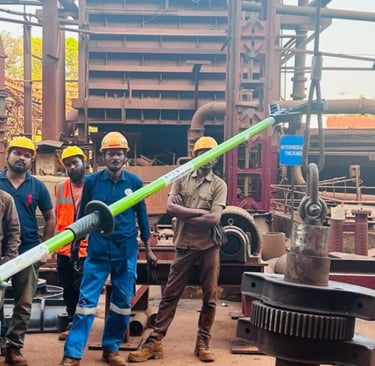
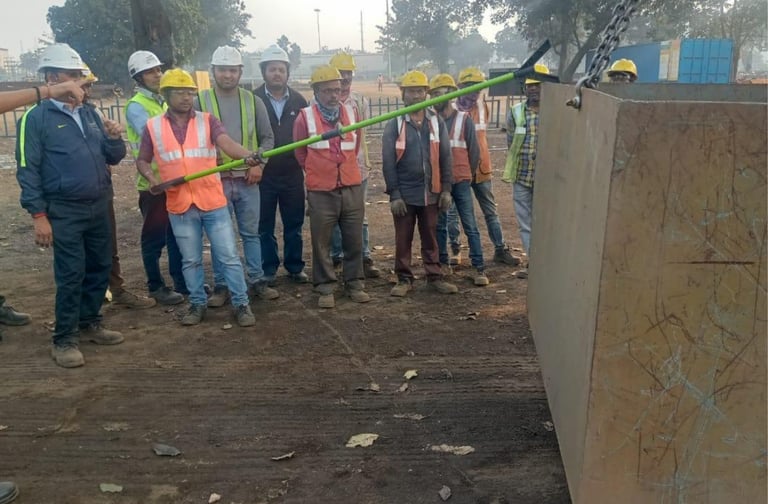
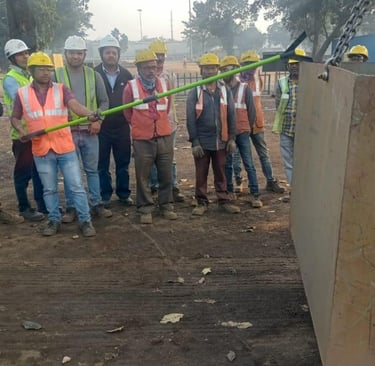
Application Images


3A, 3rd floor, Founta Plaza, Suryabagh, Visakhapatnam-530020, AP, India.
+91 9100932334
info@projectsalescorp.com
pschandsfree.com


Dubai Silicon Oasis, Building A1, IFZA Business Park, DDP, Dubai, United Arab Emirates
(+971) 50-457-2844
info@pscdubai.com
pscdubai.com


134 Vintage Park Blvd, Ste A #1006, Houston, TX 77070
(984) 322-1807
info@pschoustonllc.com
pschoustonllc.com